Long A eɪ - FACE, BAKE
Front unrounded diphthong, starting from close-mid then falling to near-close.
eɪ
As seen on television
- Face /feɪs/
- Make /meɪk/
- Cake /keɪk/
- Eight /eɪt/
- Gray /ɡreɪ/
- Aim /eɪm/
- Break /breɪk/
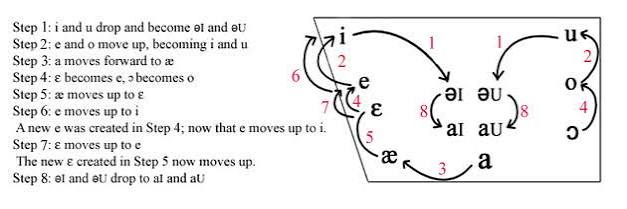
Long A in Great Vowel Shift
## In context of [[Great Vowel Shift]]
> [!important]
> Unlike how the other vowels shifted, the long a experienced multiple changes over time.
Middle English /aː/
↓
/æː/
↓
/ɛː/
↓
/eː/
↓
Modern /eɪ/
During the Great Vowel Shift:
- Long **high vowels** couldn't move any higher, so they **broke into diphthongs**.
- Lower long vowels **moved upward** into the spaces the high vowels had vacated.
- Once Middle English /aː/ had risen through /ɛː/ to /eː/, this vowel later diphthongized into Modern English /eɪ/.
This is often described as a **chain shift**: as one vowel moved, it created space that another vowel moved into, preserving distinctions between vowels.
---
## Classical Great Vowel Shift chart
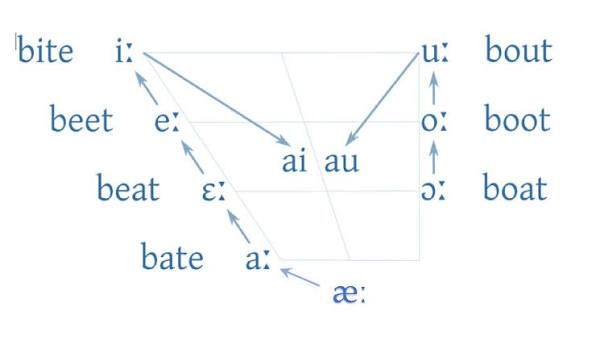
The GVS chart is simplified.
While other words became Monothong when shifted, long a became a [[Diphthong]]
- Middle English **/iː/** became **/aɪ/**
- Middle English **/uː/** became **/aʊ/**
- Middle English **/aː/** did **not** become another long monophthong. Instead, over time it became the diphthong **/eɪ/**.
Many simplified charts stop before showing these final modern diphthongs (except for /aɪ/ and /aʊ/, since those are the most dramatic changes).
How to make long a sound
It is a [[Diphthong]]
To pronounce the sound, begin with the tongue pushed somewhat forward but in a neutral position in the mouth. Then, as the jaw closes slightly, move the body of the tongue upward until it is near the [tooth ridge](https://amanda-lillet.squarespace.com/the-vocal-tract)--similar to the position of a '[y sound](https://pronuncian.com/pronounce-y-sound)' **/y/**. The front sides of the tongue touch the inside of the top teeth at the end of the sound.
---
![[Pasted image 20260723145820.png]]
<iframe width="400" height="400" src="https://www.youtube.com/embed/O9o8TMoGb7A?si=2lNNyQIt6f_Ro-KA&controls=0" title="YouTube video player" frameborder="0" allow="accelerometer; autoplay; clipboard-write; encrypted-media; gyroscope; picture-in-picture; web-share" referrerpolicy="strict-origin-when-cross-origin" allowfullscreen></iframe>
When it is made:
Spellings representing long a
| Spelling | Example | Sound |
|---|---|---|
| a_e | make | /eɪ/ |
| ai | rain | /eɪ/ |
| ay | day | /eɪ/ |
| ei | vein | /eɪ/ |
| ey | they | /eɪ/ |
| ea | great | /eɪ/ |
| eigh | eight | /eɪ/ |
1. Silent E
| Without Silent e | IPA | With Silent e | IPA | Effect |
|---|---|---|---|---|
| cap | /kæp/ | cape | /keɪp/ | /æ/ → /eɪ/ |
| tap | /tæp/ | tape | /teɪp/ | /æ/ → /eɪ/ |
| mad | /mæd/ | made | /meɪd/ | /æ/ → /eɪ/ |
| hat | /hæt/ | hate | /heɪt/ | /æ/ → /eɪ/ |
| mat | /mæt/ | mate | /meɪt/ | /æ/ → /eɪ/ |
| can | /kæn/ | cane | /keɪn/ | /æ/ → /eɪ/ |
| pan | /pæn/ | pane | /peɪn/ | /æ/ → /eɪ/ |
| rat | /ræt/ | rate | /reɪt/ | /æ/ → /eɪ/ |
| plan | /plæn/ | plane | /pleɪn/ | /æ/ → /eɪ/ |
| fat | /fæt/ | fate | /feɪt/ | /æ/ → /eɪ/ |
2. In Open-Stressed syllables
What when syllable is not stressed but open?
Then the rule becomes much weaker.
Stress is important because English unstressed vowels tend to reduce to Schwa A ə or /ɪ/.
| Word | Syllable | Open? | Stressed? | Pronunciation |
|---|---|---|---|---|
| about | a·bout | ✅ | ❌ | /ə/ |
| ago | a·go | ✅ | ❌ | /ə/ |
| alone | a·lone | ✅ | ❌ | /ə/ |
| amuse | a·muse | ✅ | ❌ | /ə/ |
| aside | a·side | ✅ | ❌ | /ə/ |
More examples
| Word | Syllable Division | Open Syllable | Long Vowel | IPA |
|---|---|---|---|---|
| table | ta · ble | ta | A → /eɪ/ | /ˈteɪ.bəl/ |
| maple | ma · ple | ma | A → /eɪ/ | /ˈmeɪ.pəl/ |
| basic | ba · sic | ba | A → /eɪ/ | /ˈbeɪ.sɪk/ |
| vacant | va · cant | va | A → /eɪ/ | /ˈveɪ.kənt/ |
| nature | na · ture | na | A → /eɪ/ | /ˈneɪ.tʃɚ/ |
| agent | a · gent | a | A → /eɪ/ | /ˈeɪ.dʒənt/ |
| nation | na · tion | na | A → /eɪ/ | /ˈneɪ.ʃən/ |
| radio | ra · di · o | ra | A → /eɪ/ | /ˈreɪ.di.oʊ/ |
| potato | po · ta · to | ta | A → /eɪ/ | /pəˈteɪ.toʊ/ |
| tomato | to · ma · to | ma | A → /eɪ/ | /təˈmeɪ.toʊ/ |
| April | A · pril | A | A → /eɪ/ | /ˈeɪ.prəl/ |
| acorn | a · corn | a | A → /eɪ/ | /ˈeɪ.kɔːrn/ |
| item | i · tem | i | I → /aɪ/ | /ˈaɪ.təm/ |
| final | fi · nal | fi | I → /aɪ/ | /ˈfaɪ.nəl/ |
3. Before some nasals
| Modern Pronunciation | Lexical Set | Environment | Examples |
|---|---|---|---|
| /eɪ/ | FACE | before n | angel, change, chamber, danger, manger, stranger, arrangement, exchange, changeable |
| /eɪ/ | FACE | before m | chamber, came, name, same (not all are French loans, but same vowel outcome) |
| /eɪ/ | FACE | before ng | range, arrange, exchange, strange, danger, manger |
Quiz
These questions are based on the attached PDF.
Which IPA symbol represents the modern long A sound discussed in the PDF?
[ ] /æ/
[r] /eɪ/
[ ] /aɪ/
[ ] /eː/

The document identifies the modern long A as the diphthong /eɪ/.
The long A sound is best classified as a...
[ ] monophthong
[ ] triphthong
[r] diphthong
[ ] r-controlled vowel

The PDF explicitly describes /eɪ/ as a diphthong.
Which word is given as an example of /eɪ/?
[ ] cat
[r] face
[ ] cot
[ ] full

'Face' is one of the example words.
According to the PDF, Middle English long A ultimately became...
[ ] /æ/
[ ] /eː/
[r] /eɪ/
[ ] /aʊ/

The final stage shown is Modern English /eɪ/.
Which vowel changed into /aɪ/ during the Great Vowel Shift?
[ ] Middle English /uː/
[r] Middle English /iː/
[ ] Middle English /aː/
[ ] Middle English /oː/

The chart states /iː/ became /aɪ/.
Which vowel changed into /aʊ/?
[ ] /iː/
[ ] /eː/
[r] /uː/
[ ] /aː/

The PDF states Middle English /uː/ became /aʊ/.
Why did high long vowels become diphthongs?
[ ] They merged
[r] They could not move higher
[ ] They shortened
[ ] They disappeared

The chain shift explanation says they could not move higher.
The Great Vowel Shift is described primarily as a...
[ ] random change
[r] chain shift
[ ] stress shift
[ ] consonant shift

The document calls it a chain shift.
Which spelling commonly represents /eɪ/?
[ ] oa
[ ] oi
[r] ai
[ ] oo

The spelling table lists ai.
Which spelling is NOT listed for /eɪ/?
[ ] ay
[ ] ei
[r] igh
[ ] ey

'igh' is not listed.
Which word illustrates the spelling 'ea' for /eɪ/?
[ ] bread
[r] great
[ ] head
[ ] dead

The table gives 'great'.
Which word illustrates 'eigh'?
[ ] weight
[r] eight
[ ] height
[ ] neighbor

The table uses 'eight'.
Adding silent e changes cap into...
[r] cape
[ ] caper
[ ] cop
[ ] cope

The example table shows cap → cape.
The vowel in cap changes from...
[ ] /ɑː/ to /eɪ/
[r] /æ/ to /eɪ/
[ ] /ɪ/ to /eɪ/
[ ] /ʌ/ to /eɪ/

The silent-e examples show /æ/ → /eɪ/.
Which pair demonstrates the silent-e effect?
[r] mad–made
[ ] bag–beg
[ ] pin–pineapple
[ ] dog–dogs

The PDF includes mad → made.
Which example is used for 'ay'?
[ ] rain
[r] day
[ ] they
[ ] great

The spelling table lists day.
Which example is used for 'ey'?
[c] they
[w] grey
[ ] obey
[ ] prey

The table specifically lists they.
The tongue begins in what general position?
[ ] back and high
[r] forward and neutral
[ ] low and back
[ ] central and low

The articulation section says somewhat forward and neutral.
As /eɪ/ ends, the tongue moves...
[w] downward
[ ] backward
[c] upward
[ ] unchanged

The body of the tongue moves upward.
Near the end of /eɪ/, the tongue approaches the...
[ ] soft palate
[r] tooth ridge
[ ] uvula
[ ] pharynx

The PDF mentions the tooth ridge.
The jaw during /eɪ/...
[ ] opens wider
[r] closes slightly
[ ] does not move
[ ] drops completely

The articulation instructions specify slight closing.
Which word is NOT an example on page 1?
[w] break
[ ] aim
[ ] gray
[c] boat

Boat is not listed among the introductory examples.
The long A sound starts from a...
[r] close-mid position
[ ] open position
[ ] back rounded position
[ ] high back position

The opening description states it starts from close-mid.
Which stage immediately precedes Modern /eɪ/?
[ ] /æː/
[r] /eː/
[ ] /ɛː/
[ ] /aː/

The sequence ends ... /eː/ → /eɪ/.
According to the PDF, simplified GVS charts often omit...
[ ] all diphthongs
[r] modern diphthongs except dramatic ones
[ ] Middle English vowels
[ ] IPA symbols

The document notes many charts stop before final modern diphthongs.
Which word exemplifies the 'ei' spelling?
[c] vein
[ ] veil
[w] eight
[ ] rein

The table uses vein.
Which pair appears in the silent-e examples?
[c] rat–rate
[w] bit–bite
[ ] rid–ride
[ ] hop–hope

The final page includes rat → rate.
Plane differs from plan mainly because...
[ ] it adds a prefix
[r] it adds silent e
[ ] it doubles n
[ ] it changes stress

The PDF attributes the pronunciation change to silent e.
Which spelling pattern is associated with 'make'?
[ ] ai
[r] a_e
[ ] ay
[ ] ea

The spelling table lists a_e → make.
According to the PDF, long A experienced...
[ ] one historical change
[r] multiple historical changes
[ ] no historical changes
[ ] only spelling changes

The PDF explicitly says it experienced multiple changes.