| Value |
Data |
| Discovered |
by Harry Jasperson |
| Reason? |
Trying to differentiate from French; and to differentiate from migration of people from other parts of London to Northern end. |
| Interesting Fact |
French also went through the Vowel shift, but they did update their spelling system. |
| Timeline: |
1400-1700; changes after that are not considered in Great Vowel Shift. |
### Explanation
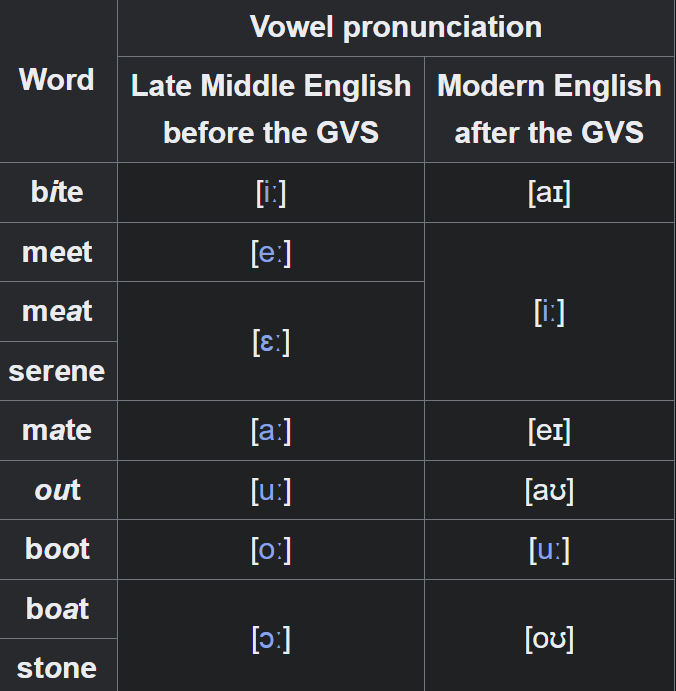
The vowels shifted their pronunciation by one place over several centuries, and this especially affected [[Long Vowel]]. This made it so that the long-vowel was no more merely the extended pronunciation of its short counterpart, but it was another sound altogether - specifically, taking the sound of long pronunciation of the sound next to it in the hieracrchy. Thus, every long-vowel sound was shifted, but the spelling was never updated to show the change.
---
### Illustration
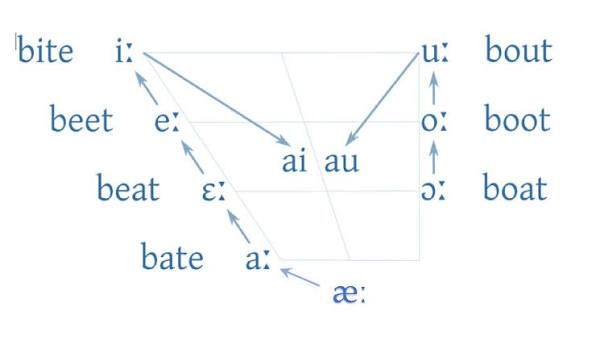
Previously, the vowels were pronounced just as elongated versions of short counterpart.
Then:
| Word | Change |
| ------- | ----------------------------------- |
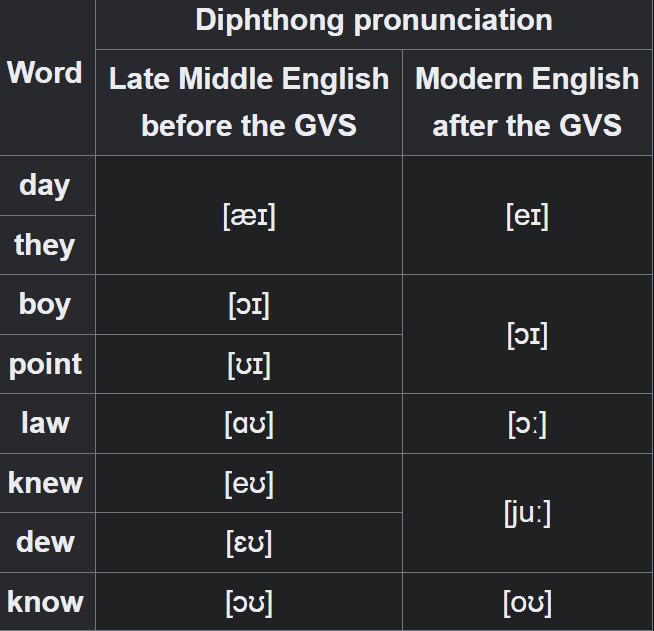
| i and u | went through [[Diphthong]]ism |
| Other 5 | underwent increase in tongue height |
### Shift in Normal voels
---
### Shift in [[Diphthong]]
!Pasted image 20260723144703.png