Broad - Open ɑː for a - Father, Palm, Calm
## Words
- Father
- Bath
- Grass
- Laugh

---

## Sentences

- Arthur's father starts the car.
- Large Lizards lurk in dark corner.
- Smart shart swim in dark.
- Marthur and Arthur park the car.
- Target the dark wall with precision.
- I asked my father to park the car in the yard of the spa.
What is it?
ɑː
The open back unrounded vowel (or low back unrounded vowel)
Key Distinction: Length (ː) vs. Quality. Non-native speakers frequently mistake /ɑː/ as merely a lengthened version of /ʌ/ (as in strut) or /æ/ (as in trap). In reality, /ɑː/ requires a distinct pharyngeal retraction that completely alters its acoustic signature.
<iframe width="560" height="315" src="https://www.youtube.com/embed/Pts9rEADVa8?si=PSy3NDYpf9fqiI0N" title="YouTube video player" frameborder="0" allow="accelerometer; autoplay; clipboard-write; encrypted-media; gyroscope; picture-in-picture; web-share" referrerpolicy="strict-origin-when-cross-origin" allowfullscreen></iframe>
---
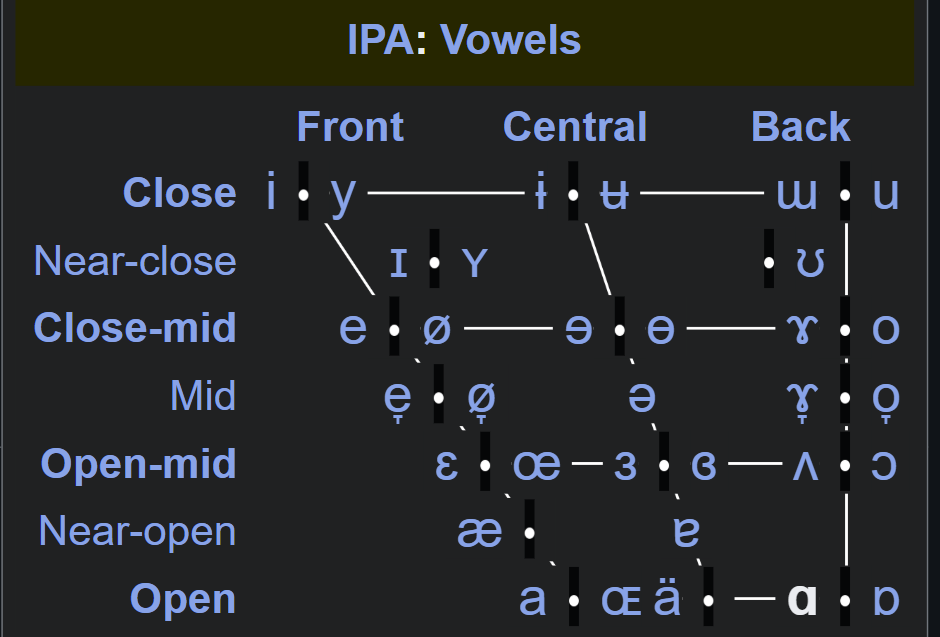
Where is it pronounced?
- Its place of articulation is pharyngeal, which means it is articulated with the tongue root against the back of the throat (the pharynx).
- It is unrounded, which means that the lips are not rounded.
| AmE | BrE |
|---|---|
| May be more front ɑ̟ ~ [ä], especially in accents without the Cot - Caught merger [1] | Typically more front than cardinal [ɑ]. It may be as front as [äː] |
Vocalic equivalent between ɑ: and ʕ̞
The open back unrounded vowel (represented as [ɑ], similar to the "a" sound in "father") is produced by lowering the tongue and pulling the tongue root back toward the throat (pharynx). If you narrow that pharyngeal space just a fraction more, the vowel transitions into a pharyngeal approximant [ʕ̞].
So, phonetically, [ʕ̞] has just enough narrowing in the pharynx to be classed as a consonant, whereas [ɑ] keeps the pharynx open enough to remain a pure vowel.
When linguists say that [ɑ] is the vocalic equivalent of [ʕ̞], they mean these two sounds share the exact same active articulators—namely, the tongue root backing toward the pharyngeal wall—just set at slightly different distances.
Vocalic Equivalance
How is it pronounced?
Phonetically, /ɑː/ represents a state of maximal acoustic resonance and minimal lingual obstruction in the oral cavity.
- **Tongue Position:** Pushed down and drawn back as far as possible into the pharynx without creating a pharyngeal fricative.
- **Lip Posture:** Fully neutral to slightly spread (unrounded).


---
<div style="width: 100%; height: 420px; overflow: hidden; position: relative; border: 1px solid #444; border-radius: 8px;">
  <iframe src="https://en.wikipedia.org/wiki/IPA_vowel_chart_with_audio#IPA_vowels" style="position: absolute; top: -180px; left: -50px; width: 120%; height: 900px; border: none;"></iframe>
</div>

**Interactive Vowel Chart**
When?
r-controlled vowels word+r
In late Middle English, pairs such as cat, cart, were pronounced [kat], [kart] respectively, distinguished only by the presence or absence of [r]. However, by the late 17th century they were also distinguished by the quality and length of the vowel.
It has affected most varieties of contemporary English, which have distinct vowels in pairs such as cat, cart. In non-rhotic accents, the /r/ of cart has been lost; in Standard Southern British the word is pronounced /kɑːt/, distinguished from cat only by the quality and length of the vowel.
When a is immediately followed by r, the r controls the pronunciation of the vowel. The usual short-a (/æ/) and silent-e (/eɪ/) patterns no longer apply. Instead, ar is pronounced as its own r-controlled vowel sound (/ɑː/ in BrE, /ɑr/ in AmE).
| Pattern | Example | IPA (BrE) | IPA (AmE) | What happened? |
|---|---|---|---|---|
| a | cat | /kæt/ | /kæt/ | Short a (/æ/) |
| a...e | cake | /keɪk/ | /keɪk/ | Long a (/eɪ/) |
| ar | car | /kɑː/ | /kɑr/ | R changes the vowel completely. |
| ar | park | /pɑːk/ | /pɑrk/ | Not /pæk/ or /peɪk/. |
| ar | star | /stɑː/ | /stɑr/ | R creates the "ar" sound. |
| ar | hard | /hɑːd/ | /hɑrd/ | R-controlled vowel. |
| ar | farm | /fɑːm/ | /fɑrm/ | R-controlled vowel. |
not every a + r sequence is pronounced /ɑː/. Common patterns like are (care), air (fair), and ear (bear) have different pronunciations (/eə/ in BrE, /er/ in AmE). Those are separate spelling patterns built on ar, but they don't follow the basic ar → /ɑː/ pattern.
Why does Carrot not have the long a sound?
This lengthening occurred when /a/ was followed by non-pre-vocalic /r/; it did not generally apply before intervocalic /r/ (when the /r/ was followed by another vowel). Hence the first vowel of carrot and marry has normally remained the same as that of cat.
Then why do Barring and Starry have long a?
Inflected forms and derivatives of words ending in (historical) /r/ generally inherit the lengthened vowel, so words like barring and starry have /ɑː/ as do bar and star.
Broadening before Fricative f, θ, s
Occurance rules
Rarity
- It is inconsistent and sporadic
- Broadening affected Standard English extremely inconsistently. It seems to have been favored when /a/ was adjacent to labial consonants or /r/.
- It is apparent that it occurred most commonly in short words, especially monosyllables, that were common and well-established in English at the time broadening took place (c. 1500–1650).
- Words of 3 or more syllables were hardly ever subject to broadening. Learned words, neologisms (such as gas, first found in the late 17th century), and Latinate or Greek borrowings were rarely broadened.
Sounds before which broadening occurs
- Broadening of a happens before preconsonantal or morpheme-final voiceless fricatives /f, θ, s/
- The voiceless fricative /ʃ/ has never promoted broadening in Standard English in words like ash and crash.
So why is Father broadened when it does not has any of those three sounds?
A particularly interesting case is that of the word father. In late Middle English this was generally pronounced [ˈfaðər], thus rhyming with gather [ˈɡaðər]. Broadening of father is notable both in two respects:
- its occurrence before an intervocalic voiced fricative [ð]
- its distribution in many accents that do not otherwise have broadening, such as those of North America.
The Oxford English Dictionary describes the broadening of father as "anomalous"
Dobson, however, sees broadening in father as due to the influence of the adjacent /f/ and /r/ combined. Rather and lather appear to have been subject to broadening later, and in fewer varieties of English, by analogy with father.
Broadening spreading to its other forms
- Once broadening affected a particular word, it tended to spread by analogy to its inflectional derivatives. For example, from pass ([paːs]) there was also passing [ˈpaːsɪŋ].
- In a phenomenon going back to Middle English, [f, θ] alternate with their voiced equivalents [v, ð]. For example, late Middle English path [paθ] alternated with paths [paðz]. When broadening applied to words such as path, it naturally extended to these derivatives: thus when [paθ] broadened to [paːθ], [paðz] also broadened to [paːðz]. This introduced broadening into the environment before a voiced fricative.
| Environment | RP /æ/ as in TRAP ("flat A") | RP /ɑː/ as in PALM or FAther ("broad A") |
|---|---|---|
| _[f] | carafe*, chiffchaff, gaffe, naff, riffraff | calf**, chaff*, giraffe, graph (telegraph, see above), half**, laugh**, staff |
| _[f]C | Daphne, hermaphrodite, kaftan, naphtha | aft, after, craft, daft, draft/draught**, graft, laughter**, raft, rafter, shaft |
| _[θ] | hath, math (abbrev. for mathematics) | bath, lath*, path |
| _[θ]C | athlete, decathlon (pentathlon, biathlon, etc.), maths | |
| _[s] | alas*, ass (donkey), ass (term of abuse), crass, gas, lass, mass (amount), Mass (religious service) | brass, class, glass, grass, pass |
| _[sp] | asp, aspect, aspen, aspic (jelly), aspirant, aspirin, Diaspora, exasperate*, jasper | clasp, gasp, grasp, hasp*, rasp |
| _[st] | aster, asteroid, astronaut (astronomical, etc.), bastion, blastocyst (blastopore, etc.), canasta, castanets, chastity, elastic, fantastic, gastric, gymnastic, hast, Jocasta, mastic, masticate, mastiff, mastitis, mastoid, mastodon, masturbate, monastic, onomastic, pasta, pastel, plastic, procrastinate, Rastafarian, raster, sarcastic, scholastic, spastic | aghast, avast, bastard*, blast, cast, caster, fast, ghastly, last, mast, master, nasty, past, pasteurize, pastime, pastor, pastoral, pasture, plaster, repast, vast |
| _[sk] | Alaska, Basque, emasculate, gasket, Madagascar, mascot, masculine, masquerade, Nebraska, paschal*, vascular | ask, bask, basket, cask, casket, flask, mask, masque*, rascal, task |
| _[sf] | blasphemy* | |
| _[ð] | blather, fathom, gather, slather | father, lather*, rather |
| other (see below) | calve**, castle, fasten, halve**, raspberry | |
| The words castle, fasten and raspberry are special cases where subsequent sound changes have altered the conditions initially responsible for lengthening. In castle and fasten, the /t/ was pronounced, according to a slight majority of 16th and 17th century sources. In raspberry we find /s/ rather than /z/. |
Compensatory lengthening
In case of compensatory lengthening of the short /a/ in words like calm, palm, psalm when /l/ was lost in this environment
Before Nasals m, n, ŋ
Some words in middle English with the /au/ diphthong developed to broad a.
The words in which a occurred before nasals, which were lengthened after the Great Vowel Shift became Broad a, but note that a before nasal word takes 4 types of sounds based on history. See Nasals and A
| Modern Pronunciation | Lexical Set | Environment | Examples |
|---|---|---|---|
| /ɑː/ | BATH (RP) | before n | dance, chance, advance, answer, branch, command, demand, grant, glance, France, romance, plant, can't, shan't, aunt (many RP speakers) |
| /ɑː/ | PALM | before m | calm, balm, palm, psalm, qualm |
| /ɑː/ | PALM | before n | alms, almond (first syllable), half-palm compounds |
| /ɑː/ | BATH/PALM | before ng | (very few native examples) |
Foreign borrowings
spa, taco, llama, drama, piranha, Bahamas, pasta, Bach